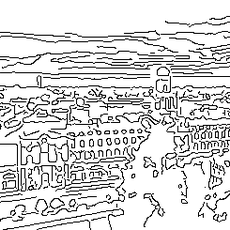
The course focuses on the key methods and approaches of image processing. The course concerns the key sections of image procesing, such as histograms, profiles, projections, low-pass and high-pass filters, geometric transformations, distortion correction, and image morphology analysis. During the practical part, the students obtain skills of image processing using the OpenCV open-source library.
I chose this course because I wanted to understand the basics of image processing and learn how to use them in Python with OpenCV. The course helped me connect the theory with actual code. Morphological operations and watershed segmentation were especially interesting to me, since they showed how simple operations can be combined to separate touching objects.
I liked the visual examples and the coding exercises after each topic. Seeing the results made it easier to understand what each method does and how different parameters affect the image.
One thing that could be improved is the consistency between the explanations, sample code, and task descriptions. Some typos and mismatched variable names made a few exercises harder to follow. Clearer requirements and more useful feedback on failed submissions would help.
Overall, this course gave me a useful foundation in image processing and more confidence working with OpenCV.
This section introduced mathematical morphology, which felt like a completely different way of thinking compared to the filtering and histogram methods covered earlier. Instead of computing weighted sums or looking at intensity distributions, morphology asks a purely geometric question: does a given small shape fit inside the object or not? That shift from intensity to shape was the most valuable new idea for me.
The four basic operations build on each other nicely. Dilation and erosion are the primitives — dilation expands the object, erosion shrinks it. What I found most useful was realizing that opening and closing are just these two combined in opposite orders. Opening (erode then dilate) removes small protrusions outside the object, while closing (dilate then erode) fills small holes inside it. Once I saw them as "erode first" vs "dilate first", the naming stopped being confusing. One thing that genuinely surprised me: erosion makes internal holes bigger rather than smaller, which is the opposite of what I expected.
The structuring element turned out to be the key design choice. It is basically a binary kernel, similar to the convolution kernels used for 2D filters, but here only its shape and size matter — not the weights. Changing from an 11×11 ellipse to a rectangle gives visibly different results, so selecting the right element is really where the practical skill lies. The star-image example was the clearest part of the whole section: watching it dissolve step by step under repeated erosion made the abstract definition concrete immediately, and the OpenCV API is compact enough that getStructuringElement() plus morphologyEx() covers everything without boilerplate.
As for improvements: a few task descriptions contained typos or leftover copy-paste errors — for instance, a CLAHE task whose note still referred to equalizeHist(). These were easy to figure out but cost some time. It would also help to have a short note on how to choose clipLimit and tileGridSize for CLAHE, since the default settings produced noticeably noisy output and it was not obvious which parameter was responsible.
I chose this course because I wanted a practical introduction to digital image processing with Python and OpenCV, covering both the underlying theory and the coding side. It fit my expectations well: every method is demonstrated on real images rather than stopping at formulas, which makes the connection between the math and the visual result easy to follow.